
If like me, you have Hypermobile Ehlers-Danlos Syndrome (hEDS), you are likely no stranger to strange, seemingly disconnected symptoms. But a few things are as unnerving, exhausting, or deeply misunderstood as air hunger, which is a persistent, frustrating sensation that you just can’t get a deep, satisfying breath, even when you are sitting perfectly still and upright.
If you have ever tried to explain this to a doctor, only to be met with blank stares, normal chest X-ray resukts, and a suggestion that “it’s just your anxiety,” then you are not alone. Let’s talk about why hEDS makes us feel like we are constantly running out of air, why it so often goes undiagnosed, and how to use home respiratory tools to reclaim your breath.
Why hEDS Messes With Your Breathing
It’s easy to think of breathing as just a simple lung function, but our lungs don’t work in a vacuum, they actually rely on a complex network of muscles, joints, nerves, and connective tissue to pull air in and push it back out again.
Because hEDS alters the collagen that holds all of these systems together, our respiratory mechanics can take a serious hit:
- Floppy Chest Walls & Weak Muscles: The diaphragm and intercostal rib muscles have to work twice as hard to expand a highly flexible, unstable rib cage. Over time, these muscles fatigue, leading to shallow, inefficient breathing.
- The “Sensorimotor” Mismatch: Emerging research suggests that the hEDS brain struggles with proprioception, which is our internal map of where our body parts are. This can cause a disconnect where our brain believes our lungs aren’t expanding enough, triggering a constant, false alarm of air hunger even if our oxygen levels are actually perfect.
- The Dysautonomia Connection: Many people with hEDS also manage POTS (Postural Orthostatic Tachycardia Syndrome). Autonomic nervous system dysfunction can cause abnormal breathing rhythms and blood pressure fluctuations that mimic shortness of breath, especially when standing upright.
- Mast Cell Activation (MCAS): If our mast cells are reactive, they can trigger mild, transient airway inflammation or micro-bronchospasms that feel exactly like asthma but don’t always respond to standard inhalers.
The Diagnosis Trap: Why You’re Dismissed
The main reason hEDS-related breathing issues go undiagnosed is that traditional lung tests are designed to look for disease, not structural instability or neurological coordination issues.
When you get a spirometry test or a chest X-ray at the GP, they are checking for conditions like COPD or pneumonia. In hEDS, our actual lung tissue is usually completely healthy. The issue is in the pump which includes the muscles and ribs, and the signals from the brain and nerves. When these tests come back normal, doctors frequently misattribute the symptoms to generalised deconditioning or panic attacks.
How To Seek Answers
If you want to get to the bottom of your breathing issues, then sadly standard paths might not cut it. Consider advocating for:
- A referral to a Dysautonomia or Joint Hypermobility specialist who understands the neurological and structural components of hEDS.
- Cardiopulmonary Exercise Testing (CPET), which evaluates how your lungs, heart, and muscles interact under actual stress rather than at rest.
- Working with a Respiratory Physiotherapist who specialises in hypermobility to evaluate your breathing patterns for hyperventilation syndrome or paradoxical vocal fold movement.
Training Our Lungs At Home
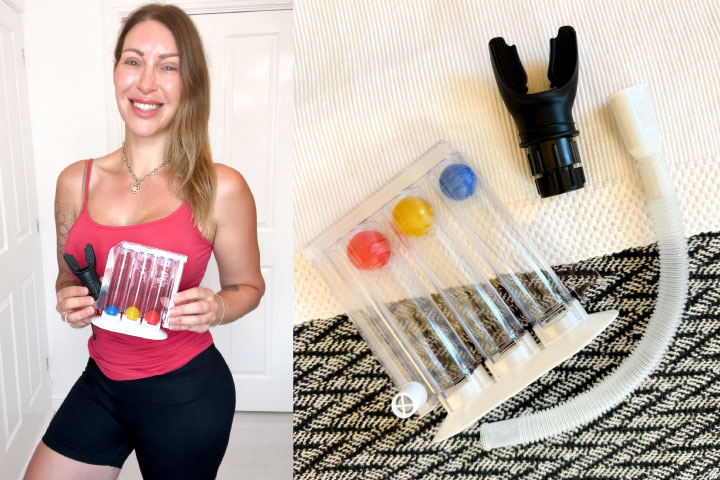
Just like we use physical therapy to stabilise our hypermobile joints, we can also train our respiratory muscles to cope with the extra workload. If you purchase a 3-ball incentive spirometer and an adjustable lung trainer, then you have an excellent, science-backed home gym for your lungs. Let’s take a closer look at how to use both of these devices effectively without triggering flare-ups.
The 3-Ball Incentive Spirometer: Inhalation Focus
The 3-ball spirometer is designed to help you to take deep, slow and sustained inhalations. This opens up the tiny air sacs known as alveoli at the very bottom of the lungs, which often stay collapsed when we fall into shallow hEDS breathing patterns.
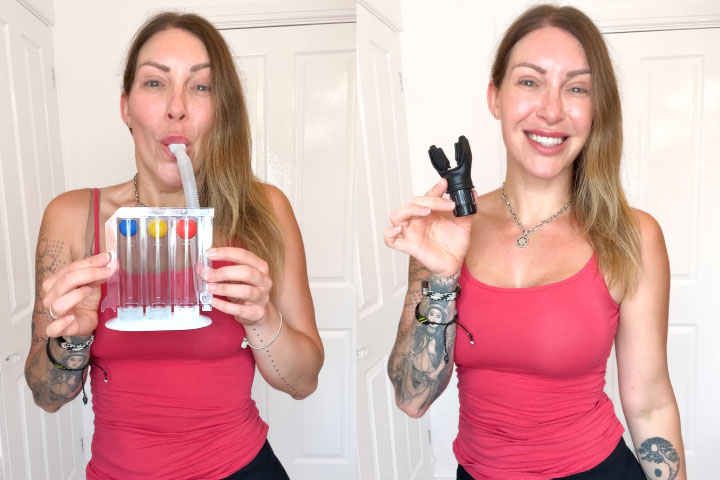
Sit upright, you first exhale fully and naturally to empty your lungs. Placing the mouthpiece in your mouth, form a tight seal with your lips and inhale slowly and deeply. The goal is to lift the balls one by one. A slow, steady pull is much better for lung expansion than a quick gasp.
Once the balls are all up in the air, try to hold your breath for 3 to 5 seconds to keep them elevated before removing the mouthpiece and exhaling normally. Aim for 5 to 10 slow breaths per session. If you feel dizzy then stop immediately and rest.
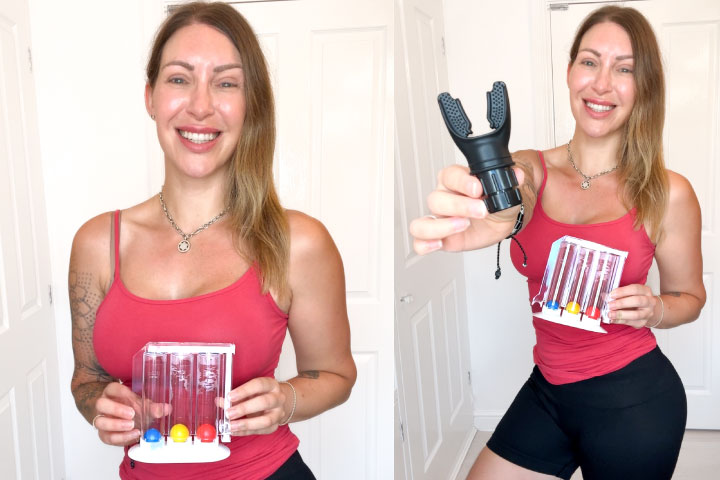
The devices features three coloured balls of varying pressure required to move them. The red ball requires 600cc/sec, the yellow ball 900cc/sec and the blue ball 1200cc/sec. I can inhale and lift all three balls for a couple of seconds before running out of breath, but cannot exhale and lift the blue ball at all. Most people can generate expiratory flow rates well above 1200cc/sec during a forceful blow such as blowing up a balloon.
This shows me the areas of weakness in my lungs that I hope to be able to improve on through at home lung training. I hope to eventually be able to raise the balls in a slow and controlled inhale for a longer duration, as well as eventually lift the blue ball during exhalation.
Key Benefits of using this device:
- Maximises lung volume and improves overall ventilation efficiency
- Encourages diaphragmatic breathing, taking pressure off of your tired neck and chest muscles
- Provides instant, reassuring visual feedback that your lungs can take in air, helping quieten air hunger anxiety
The Blue Rose UK Lung Trainer: Resistance Focus
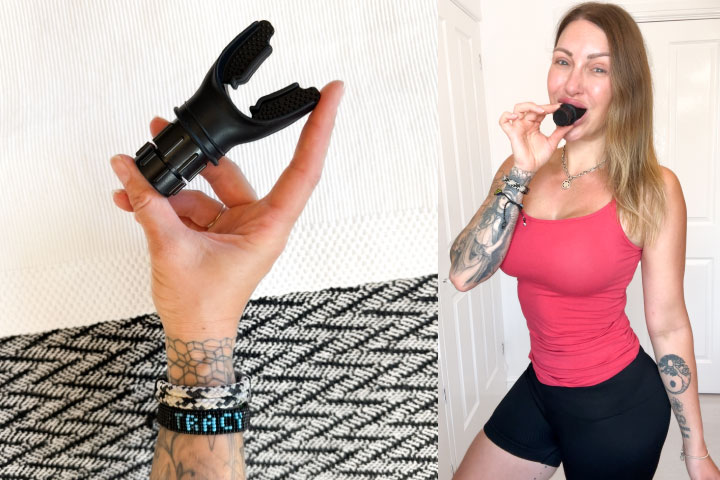
While the spirometer focuses on volume and expansion, the adjustable lung trainer acts like a weight machine for our breathing muscles. By breathing against resistance, we force our diaphragm and intercostals to grow stronger and more resilient.
Start with the adjustable dial set to the lowest resistance available. Because hEDS muscles fatigue quickly, starting too heavy can cause unnecessary rib strain. Insert the mouthpiece and seal your lips around it. Take a deep, forceful breath in against the resistance, then exhale firmly through the device.
Practice for 5 to 10 minutes a day. As your muscles adapt over 2 to 4 weeks, you can slowly turn the dial to increase the resistance. Since you are breathing directly into it, it’s advised to wash the mouthpiece daily with warm, soapy water to keep it clean.
Key Benefits of using this device:
- Inspiratory Muscle Training (IMT): Significantly builds stamina in the muscles responsible for breathing, making daily activities feel less taxing
- Customisable Progress: The adjustable dial lets you scale your therapy to match your good and bad symptom days
- Aids Airway Clearance: The resistive pressure can help to mobilise any trapped secretions or mucus, keeping your airways clear and reducing irritation
Be Kind To Your Lungs
Remember, training your respiratory system with hEDS is a marathon, not a sprint. If you are having a high-pain day, or your ribs are feeling particularly subluxed or unstable, please prioritise the gentle expansion of the 3-ball spirometer over the heavy resistance of the lung trainer.
Listen to your body, give yourself permission to rest when you feel lightheaded, and remember: your air hunger is real, it is structural, and you have the power to help train your body through it.
