
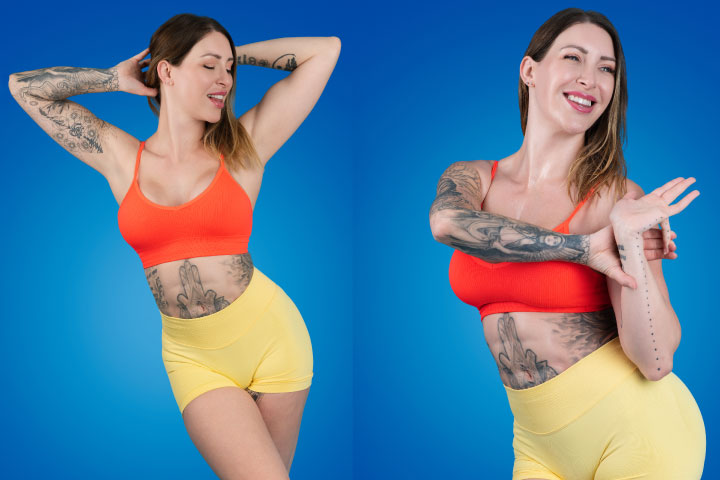
From the outside looking in, perhaps you see me as a working mother of two rushing through the morning routine, tackling a never-ending to-do list, and keeping the gears of a busy household turning. You might see a fitness portrait from a recent photoshoot and think that I look completely healthy and strong. But what you don’t see is the invisible matrix of faulty scaffolding holding me together; or, more accurately, failing to.
You see, I live with Hypermobile Ehlers-Danlos Syndrome (hEDS) which is a lifelong, multisystemic condition caused by a defect in collagen, the very glue that supports all of our joints, skin, muscles, and organs. Because hEDS is an invisible illness, people rarely realise what it takes just to pull back the duvet, put my feet on the floor, get out of bed and keep going.
To bring that hidden reality to light, I recently stepped in front of the camera for a very personal photoshoot. I wanted to capture the stark contrast between how the world sees me and what my body actually experiences. Because, to the untrained eye these two realities are poles apart.
hEDS: The Facts Behind Faulty Collagen
When people hear hypermobility, they often think of a neat party trick, like being flexible or double-jointed. But hEDS is so much more than that. Because collagen is found absolutely everywhere in the body, its fragility causes widespread, often debilitating symptoms.
Even though recent studies suggest hEDS and its cousin, Hypermobility Spectrum Disorder (HSD), may affect as many as 1 in 500 people, it still remains heavily underdiagnosed and misunderstood. On average, it takes an astonishing 10 to 19 years for an individual to receive an accurate diagnosis, and for me, I was diagnosed at the age of 36yrs old after a stranger online spotted my symptoms and made me aware of them.
There are in fact 13 distinct types of Ehlers-Danlos Syndrome in total, while the other 12 rare types can be confirmed with a genetic blood test, hEDS is the only subtype with no identified genetic marker. Diagnosis relies entirely on strict clinical criteria and physical assessments for which I tick all of the boxes, yet had never even heard of it nor thought that I was any different to everybody else, until I couldn’t stop collapsing for no apparent reason.
Sadly, hEDS doesn’t just affect the joints of the body, as a national UK survey found that 83.9% of patients live with chronic, widespread pain, 73.8% experience frequent joint subluxations or partial dislocations, and 66.3%suffer from severe gastrointestinal issues which have been extremely painful for me.
Measuring Energy In Spoons?
When you have a limited amount of daily energy from a chronic condition, you quickly learn to view your life through Christine Miserandino’s famous Spoon Theory.
Imagine waking up every single morning with exactly 12 spoons in your hand. Every single task you perform costs you a spoon. Showering? That’s a spoon. Getting the kids dressed and fed? Two spoons. Driving to work, typing an email, making dinner… each takes its toll and eats away at the stock of energy that you have left.
Healthy people have an unlimited supply of spoons; if they run low, well a good night’s sleep replenishes them. But for someone with a chronic illness, our spoon drawer is strictly rationed, and we often wake up already in deficit, feeling worse than before we even went to sleep. When I’m in severe pain and my inflammation overwhelms me, it takes days of my life to recover from something as simple as a walk, or even doing the laundry.
Lately, my spoon economy has completely crashed which led me to seek answers and evidently diagnosis. My energy levels don’t just dip; they fluctuate wildly because my body has begun collapsing more frequently and without warning. It is terrifying to feel your legs completely give way or your nervous system misfire in the middle of a room, forcing an immediate, involuntary halt. But that is now the reality of my life which I’m gradually trying to understand, be proactive with and predict burnout. Although, at the minute it feels like I’m on a bit of a rollercoaster and helpless to know what will happen next or when. Will it be a good day or bad? Will I feel strong for the next hour or broken? Can I make plans for the weekend or must I wait several weeks to feel ok again?
The Ultimate Tightrope: Motherhood, Work & Survival
Being a working mom of two is a beautiful, chaotic whirlwind under normal circumstances. Doing it with hEDS means literally living on a knives’ edge.
Every single day is a calculated math problem. If I push through the fatigue to finish a work project or stay up to clean the kitchen, I am actively stealing spoons from tomorrow. If I miscalculate, the tax is brutal. I have to rigidly balance my rest and aggressive recovery time just to avoid the catastrophic baseline of being completely bedridden. And as I creep ever closer to my fortieth birthday (October 2027) I’ve had to finally self-medicate to achieve enough deep sleep to try to keep my body going each day.
It is an exhausting mental burden, trying to be present for my children and productive at my job, while my body is constantly screaming that it’s running out of fuel and threatening to leave me stranded in the middle of my day without warning.
Capturing The Invisible: The Photoshoot
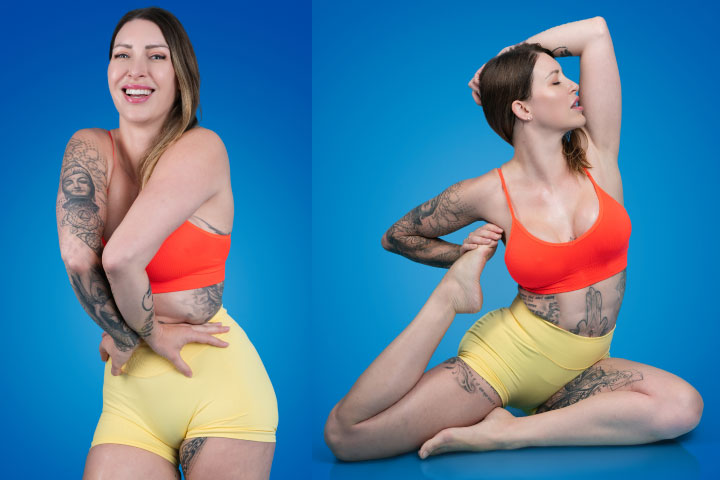
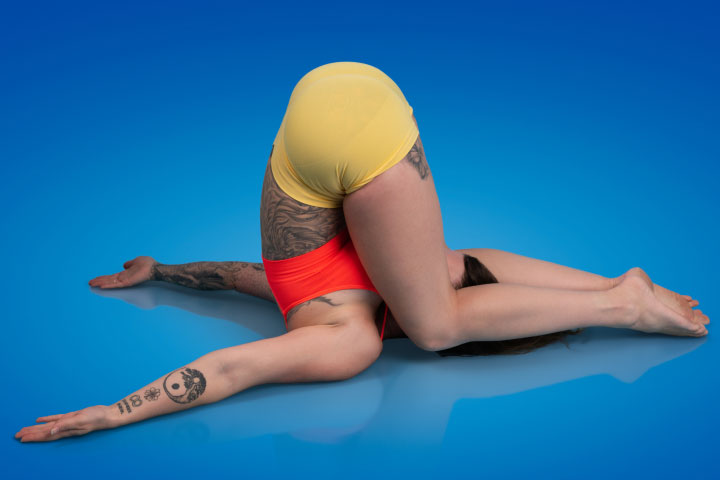
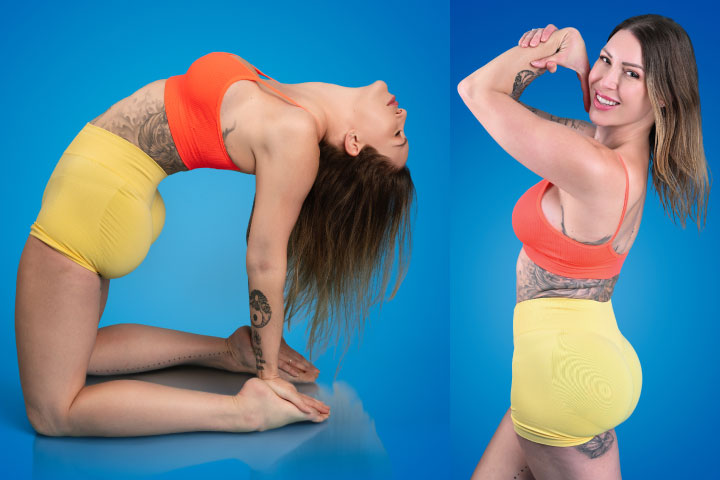
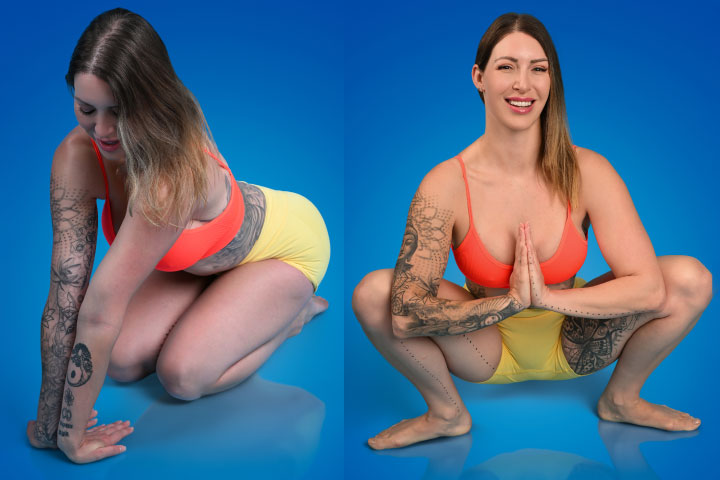
This brings me to my recent photoshoot with the amazing Gareth Davies Photography. I wanted to capture the physical aspects of my hidden disability to make something that I have suffered in silence from, for my entire lifetime, an obvious and understandable reality to others.
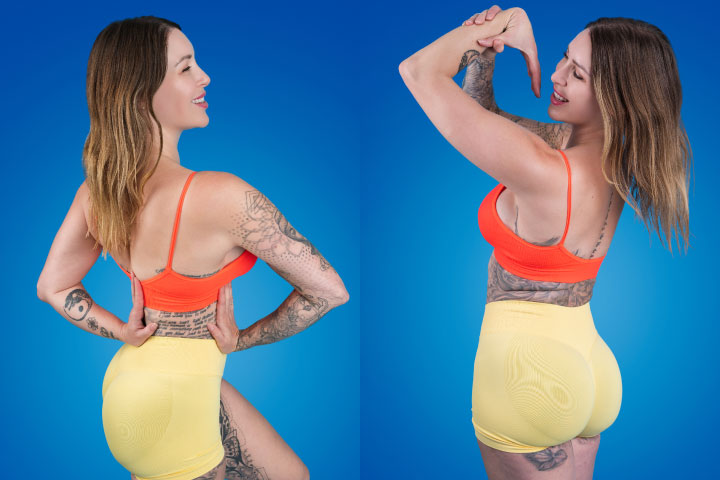
In these photos, you see my unstable joints being oddly out of place. You see my muscles fighting to hold my bones together. You see the sheer, heavy exhaustion that leads to collapse, juxtaposed with the smile that I put on to be brave and not caused my loved ones to worry about me.
I hope that these beautiful, artistic images show that not all disabilities are visible. The world praises chronic illness warriors for “looking so well,” without realising that “looking well” takes an absolutely immense amount of energy and masking, which also means bedrest and recovery to follow.
Why Awareness Changes Everything
Sharing these photos and writing this feature isn’t about asking for pity; it’s about demanding visibility. Because hEDS has no genetic test and is poorly understood by many frontline healthcare professionals, thousands of people, most disproportionately women, are left suffering in silence for a lifetime like I was, being told that their full-body pain or unpredictable collapses are simply anxiety, stress or “all in their head.”
Raising awareness and understanding for rare and hidden disabilities like mine is a literal lifeline. When we talk openly about hEDS, we give others the vocabulary to understand and accept their own bodies. It empowers people to fight for a clinical diagnosis, to access proper physical therapy, and implement pacing strategies before they reach a point of total physical burnout or collapse as I did.
Everyone deserves the chance to seek answers about their health, access the right care, and ultimately lead a healthier, higher quality of life. Until then, I’ll keep counting my spoons, protecting my peace, and showing the world exactly what invisible illness looks like.
